Grader Operator/Maintenance Worker II (CDL Not Required) - Miller/Gibbon/Pleasanton Area
General Purpose:
Operate, light,
medium, heavy equipment, road maintenance and manual labor
Full Job Description
Applicants must
complete a standard application available at www.buffalocounty.ne.gov/employment. Incomplete applications will not be
considered.
Qualifications:
High School diploma or equivalent. Combination of equivalent education and/or work experience may be considered if substantially related to the detailed job requirements of the this position
At least one year experience as a laborer, in driving dump or similar trucks, light equipment in maintenance and construction or similar work
Appropriate trade school training is desirable
Must possess a valid State of Nebraska Driver’s License
Wages: $20.50/hour
Application Submission:
Please submit
complete application, resume, and cover letter to:
Buffalo County
Board Administrator
1512 Central
Avenue
PO Box 1270
Kearney,
NE 68848
lmartin@buffalocounty.ne.gov
This position is open until filled.
Truck Driver/Maintenance Work II (CDL Required) Kearney Area
Truck
Driver/Maintenance Worker II (CDL Required) Kearney Area
General Purpose:
Operate, light, medium, heavy equipment, road maintenance and manual
labor
Applicants must complete a Standard Buffalo County Job Application. Incomplete applications will not be
considered.
Qualifications:
- High School diploma or equivalent. Combination of equivalent education and/or work experience may be considered if substantially related to the detailed job requirements of the this position.
- At least one year experience as a laborer, in driving dump or similar trucks, light equipment in maintenance and construction or similar work.
- Appropriate trade school training is desirable.
- Must possess a valid State of Nebraska Driver’s License
- Commercial Driver’s License with Class A Endorsement is required.
Wages: $21.00/hour
Application Submission:
Please submit complete application, resume, and cover letter to:
Buffalo County Board Administrator
1512 Central Avenue
PO Box 1270
Kearney, NE 68848
lmartin@buffalocounty.ne.gov
This position is open until filled. First review of applications will occur on May 2, 2022.
Full Job Description
Traffic
Purpose:
The Traffic Division of the Buffalo County Attorney’s Office prosecutes all violations of the Nebraska Rules of the Road, including driving under the influence and speeding, game and parks violations, and more.
Additionally, the Division enforces selected provisions of the Kearney City Code that pertain to traffic and advises law enforcement on traffic issues.
Find information on Nebraska’s Point System for drivers licenses.
Do you have a Buffalo County traffic citation? You have these options:
- Contest the citation. Personally appear in the Buffalo County Court on the date and time given on your citation and invoke your right to trial. See the rights you have as an accused person.
- Pay the citation by waiver. Pay the fines and costs no later than your court date without appearing in court. This can be done online. Waiver fines are set by the Nebraska Supreme Court for those who wish simply to pay their ticket without going to court over it. For more information, view the Nebraska Supreme Court Waiver Fine List .
- Inquire about the STOP class. The Safety Training Option Program (STOP) class is offered by the Nebraska Safety Center to individuals who have been ticketed for committing a minor traffic violation. It takes four hours to complete. It is voluntary. By completing it, the violator pays no fine, has no court appearance, has no points assessed on their driving record, and can improve their driving skills.

The Nebraska Safety Center offers this program across the State. For more information or to register, call the Safety Center at (308) 865-1287 or register online at www.unk.edu/stop.
Classes are held the first Sunday of the month from 1:00 p.m. to 5:00 p.m.; the third Saturday of the month from 8:00 a.m. to 12:00 p.m.; and the fourth Monday of the month from 6:00 p.m. to 10:00 p.m. Holiday times may vary.
All classes are held at:University of Nebraska at Kearney
West Center
Room 012N
Kearney, NE 68849
(Map information)
YOU MUST REGISTER FOR STOP WITHIN FIVE BUSINESS DAYS OF THE OFFENSE, AND COMPLETE THE CLASS WITHIN 21 DAYS OF THE OFFENSE.
You are not eligible for the STOP class if your citation is for:
- Speeding twenty (20) or miles per hour over the speed limit.
- Leaving the scene of an accident.
- Driving under the influence of alcohol or drugs.
- Reckless driving or willful reckless driving.
- Participating in a speed contest, race, or exhibition of acceleration.
- Operating a motor vehicle to avoid arrest.
- Driving on a suspended or revoked operator’s license.
- Operating a motor vehicle without insurance or proof of financial responsibility.
- Any injury accident or violation which is classified as a misdemeanor or a felony.
Also, you are not eligible for the STOP class if:
- You hold a Commercial Driver’s License (CDL), even if you were cited while operating a non-commercial vehicle.
- You have participated in any STOP class within the last three (3) years.
- You wish to contest your citation.
Meeting these eligibility requirements is the responsibility of the participant.
HOW TO REGISTER:
- Call the Nebraska Safety Center at (308) 865-1287, or visit their website, www.unk.edu/stop, for more information.
- Download the registration form.
Shelter in Place
What is Shelter-in-Place?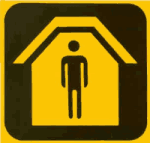
In a situation where a serious hazardous chemical spill has quickly caused a toxic atmosphere, it may be more dangerous to go through those toxic vapors or to attempt to outrun them than to stay in an existing structure. Shelter-in-Place means to get to the inside of a building and remain there during a chemical emergency rather than attempting to evacuate the area. Shelter-in-Place is a viable option for protection against exposure to potentially dangerous airborne chemicals during an emergency.
Why Should I Shelter-in-Place?
During a hazardous materials incident, the idea is to keep everyone's exposure to any chemical as low as possible. It is best to get out of the area and have no exposure, but in a sudden chemical release there may not be time to safely evacuate. In such cases, attempts to evacuate could place you at greater risk of exposure than if you had stayed in your home or workplace. Shelter-in-place is used when there has been a serious hazardous chemical spill that has quickly caused a toxic atmosphere and there is not enough time to safely leave the area. When you shelter-in-place, you take protective action in a structure to reduce exposure to toxic chemical levels. So, unless otherwise instructed to evacuate, sheltering-in-place could be the best way to safely wait out a hazardous chemical release.
How safe is it to Shelter-in-Place?
In a 2001 report by The National Institute for Chemical Studies, several studies were cited that demonstrate the value of sheltering-in-place during a chemical emergency. In older homes, the average house was found to change its air at a rate of less than 1/3
change per hour. It was also found that if one room in the house was sealed up with duct tape and plastic, the amount of chemical that was in the room after one hour was between 1/7 to 1/17 of what was outside. Another study found that sealing up a house also filtered out some of the chemicals. Not only did a sealed up house limit the amount of air coming into a house, the walls actually did some filtering of the air that seeped in. Sheltering-in-place cannot completely eliminate all exposure to the chemical, but it can keep the exposure below dangerous levels.
The report concluded: "For the vast majority of events that have led to the public to shelter-in-place, there have been no reported injuries. In fact, for a very few cases, clouds of toxic materials of sufficient concentration to cause harm have entered communities and, because sheltering-in-place has been accepted by the community and was successfully implemented, no one was injured. The body of evidence suggests that
if there is insufficient time to complete an evacuation, or the chemical leak will be of limited duration, or conditions would make an evacuation more risky than staying in place,
sheltering-in-place is a good way to protect the public during chemical emergencies."
When should I Shelter-in-Place?
A hazardous materials accident can occur anywhere. There may even be a time when you are close to where a chemical accident has taken place. If you feel or hear a strange sound like an explosion; if you see a strange cloud; if you smell a strange odor; if you feel nauseous or have burning or tearing eyes; trust your senses, don't wait for a warning confirmation and act immediately. If it is obvious that you can safely evacuate the area, do so, but remember shelter-in-place as the next option.
In Buffalo County Monitor:
|
KGFW/KQKY
|
1340 AM
|
105.9 FM
|
|
KKPR
|
1460 AM
|
98.9 FM
|
|
KHGI-TV (NTV)
|
|
Channel 13
|
|
NOAA weather radio
|
|
162.475
|
If there is a chemical release in Buffalo County, the emergency alert system will be utilized. The outdoor warning sirens will sound to alert the public to turn on a radio or television for further emergency information.
Where do I Shelter-in-Place?
If you are told to shelter-in-place or if you believe you need to, you should go inside any building close by immediately. If you are not by your own house, a church, school, or store are good options. If you are not near any buildings, your car is a better choice than staying outside. Your home is the best choice to shelter-in-place because you will know
where tapes, towels, plastics and other items are located to help you create your shelter space.
How do I Shelter-in-Place?
- Close all doors to the outside and close and lock all windows (windows sometimes seal better when locked.)
- Ventilation systems should be turned off so no outside air is drawn into the structure.
- Turn off all heating systems and all air-conditioners and switch inlets to the "closed" position.
- Seal any gaps around window type air-conditioners with tape and plastic sheeting, wax paper, or aluminum wrap.
- Turn off all the exhaust fans in kitchens, bathrooms and attics, and cover the openings with plastic wrap or plastic sheeting.
- Close all fireplace dampers and seal with plastic if possible.
- Close as many internal doors as possible in the structure you are in.
- Pick a room on the highest level of the structure, as most of the chemicals that are of concern are heavier than air and will settle in the basement.
- Select a room in the building that is comfortable and easy to seal off. The room should, if possible, provide access to water, toilet facilities, and have adequate room for people and pets to sit.
- If the vapor begins to bother you place a wet cloth over your nose and mouth. For a higher degree of protection, go into the bathroom, close the door and turn on the shower in a strong spray to "wash" the air. Seal any opening to the outside of the bathroom as best you can.
- Make sure you have a battery-powered radio and a flashlight in case the power goes out.
- Once in the room, seal windows, air vents, and exhaust fans with plastic sheeting and duct tape.
- In some homes, light switches and electrical outlets on outside walls are sources of air infiltration and should also be sealed with duct tape and plastic.
- Lastly, seal around the door with duct tape. If the space under the door is too big to seal with tape, try stuffing a damp towel under the door.
- Continue to listen to the radio or TV for emergency information and updates on the incident.
- Don't call 911 unless you have an emergency like a fire or a serious injury.
- Keep your phone available in case someone needs to contact you.
What if I can't make it to a building?
If you can get to your car, go there. Turn off the ventilation system, close your windows and vents, and tune your radio to a local station. If you are driving, try to avoid driving
through a vapor cloud and try to drive crosswind. If you are in a chemical cloud, be aware that your car may stall. If your car stalls or was not running when enveloped by the cloud, DO NOT try to start it unless told to do so by a public announcement on the radio.
If you are outside and not close to a building, such as being on a golf course or in a rural area, try to move crosswind. The vapors may drift downwind for miles and unless there is no wind at all you will not be able to outrun them. Going perpendicular to the wind, away from the center of the cloud will get you to a less harmful atmosphere quicker.
How will I know when it is safe to come out?
As soon as it is deemed safe, authorities will tell you it is safe to leave your building.
Disaster Supplies to have on hand:
- Flashlight and extra batteries
- Portable battery-operated radio
- Duct tape and plastic sheeting & wrap
- Games and toys to occupy children
- First aid kit and essential medicines
- Emergency food and water
SPECIAL NOTE: SHELTER-IN-PLACE DOES NOT APPLY TO FLAMMABLE GASES SUCH AS PROPANE AND NATURAL GASES.
Winter Weather Preparedness
Each year, the National Weather Service issues numerous watches, warnings and advisories. Knowledge of those products is a critical element in winter weather preparations.
- Winter Storm Watch - Adverse winter weather (heavy snow, blizzard) is expected within the next two days, but the exact timing, location or occurrence of the storm is still uncertain. This is the time to get prepared for the storm.
- Winter Storm Warning - Hazardous winter weather is likely. If not already occurring, it is expected to occur within 6 to 24 hours. Travel will be hazardous, if not impossible. You should be ready for the storm by this time. Stay indoors!
- Blizzard Warning - The most dangerous of all winter weather will occur in your area. A combination of winds 35 mph or greater and significant snow and/or blowing snow with visibilities less than ¼ mile for three or more hours is expected in the warning area. Blinding snow ("white out"), deep drifts and life threatening wind chill will occur. Travel will be dangerous and should not be attempted. You should seek refuge immediately!
- Winter Weather Advisory - Winter weather conditions are expected to cause significant inconveniences and may be hazardous. If caution is exercised, these situations should not become life threatening. The greatest hazard is often to motorists.
Things to do at home or work BEFORE a winter storm strikes...
Primary concerns are the potential loss of heat, power, telephone service, and a shortage of supplies if storm conditions continue for more than a day.
Have available:
- Flashlight(s) and extra batteries.
- Battery-powered Weather Radio and portable radio. These are used to receive emergency information. They may be your only link to the outside.
- Extra food and water. High-energy food, such as dried fruit or candy, and food requiring no cooking or refrigeration is best.
- Extra medicine and baby items.
- First-aid supplies.
- Emergency heating source, such as a fireplace, wood stove, space heater, etc. Make sure you know how to uses the heating sources to prevent a fire and make sure you have proper ventilation.
- Fire extinguisher and smoke detector. Test units regularly
to ensure they are working properly. Replace batteries the same weekend as the time change occurs in the spring (daylight-savings time) and fall (standard time).
On the farm....
- Move animals to sheltered areas. Shelter-belts, properly laid out and oriented, are better protection for cattle than confining shelters, such as sheds.
- Haul extra feed to nearby feeding areas.
- Have a water supply available. Most animal deaths in winter storms are from dehydration.
- Heating fuel. Fuel carriers may not reach you for days after a severe winter storm. Stay alert to changing weather conditions throughout the winter to maintain an adequate fuel supply in advance of severe weather moving into the area.
WINTER PRECIPITATION TERMS:
Snow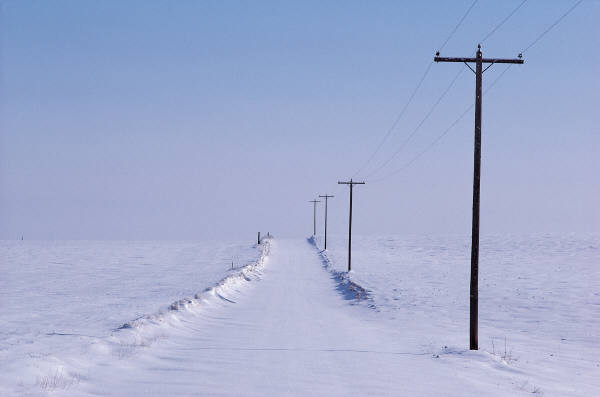
- Flurries - Light snow falling for short durations. No accumulation or light dusting is all that is expected.
- Showers - Snow falling at varying intensities for brief periods of time. Some accumulation is possible.
- Squalls - Brief, intense show showers accompanied by strong, gusty winds. Accumulation may be significant. Snow squalls are best known in the Great Lakes region.
- Blowing Snow - Wind-driven snow that reduces visibility and causes significant drifting. Blowing snow may be snow that is falling and/or loose snow on the ground picked up by the wind.
- Blizzard - Winds over 35 mph with snow and blowing snow reducing visibility to near zero.
Sleet
Is formed by raindrops that freeze into ice pellets before reaching the ground. Sleet usually bounces when hitting a surface and does not stick to objects. However, it can accumulate like snow and cause a hazard to motorists.
Freezing Rain
Is rain that falls onto a surface that has a temperature below freezing. This causes it to freeze to surfaces, such as trees, cars, and roads, forming a coating or glaze of ice. Even small accumulations of ice can cause a significant hazard.
Wind Chill
The wind chill is based on the rate of heat loss from exposed skin caused by combined effects of wind and cold. As the wind increases, heat is carried away from the body at an accelerated rate, driving down the body temperature. Animals are also affected by wind chill.
WINTER DRIVING
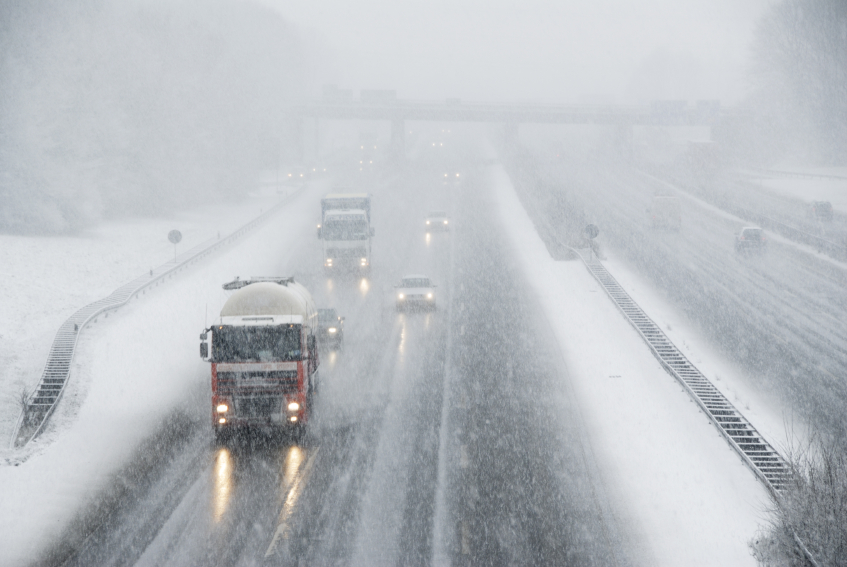
The leading cause of death during winter storms is transportation accidents. Preparing your vehicle for the winter season and knowing how to react if stranded or lost on the road are the keys to safe winter driving.
Have a mechanic check the following items on your car:
- Battery
- Antifreeze
- Wipers and windshield washer fluid
- Ignition system
- Thermostat
- Lights
- Flashing hazard lights
- Exhaust system
- Heater
- Brakes
- Defroster
- Oil level (if necessary, replace existing oil with a winter grade oil or the SAE 10w/30 weight variety)
- Install good winter tires. Make sure the tires have adequate tread. All-weather radials are usually adequate for most winter conditions.
- Keep a windshield scraper and small broom for ice and snow
removal.
- Maintain at least a half tank of gas during the winter season.
- Plan long trips carefully. Listen to the radio or Call 511 from anywhere in Nebraska for Nebraska Traveler information for the latest road conditions. Always travel during daylight and, if possible, try not to travel alone.
- Let someone know your timetable and primary and alternate
routes.
- Dress to fit the season. Wear loose-fitting, light-weight, warm clothing in several layers. Trapped air insulates. Layers can be removed to avoid perspiration and subsequent chill. Outer garments should be tightly woven, water repellent and hooded. Wear a hat. Half your body heat loss can be from the head. Cover your mouth to protect your lungs from extreme cold. Mittens, snug at the wrist, are better than gloves. Try to stay dry.
- Carry food and water. Store a supply of high-energy "munchies" and several bottles of water.
Carry a WINTER STORM SURVIVAL KIT in your vehicle that includes:
- Flashlights with extra batteries
- First aid kit with pocket knife
- Necessary medications
- Several blankets
- Sleeping bags
- Extra newspapers for insulation
- Plastic bags (for sanitation)
- Matches
- Extra set of mittens, socks, and a wool cap
- Rain gear and extra clothes
- Small shovel
- Small sack of sand for generating traction under wheels
- Small tools (pliers, wrench, screwdriver)
- Booster cables
- Set of tire chains or traction mats
- Cards, games, and puzzles
- Brightly colored cloth for a flag
- Canned fruit and nuts
- Non-electric can opener
- Bottled water
IF TRAPPED IN CAR DURING A BLIZZARD:
- Stay in the car. Do not leave the car to search for assistance unless help is visible within 100 yards. You may become disoriented and lost in blowing and drifting snow.
- Display a trouble sign. Hang a brightly colored cloth on the radio antenna and raise the car hood.
- Occasionally run engine to keep warm. Turn on the car's engine for about 10 minutes each hour. Run the heater when the car is running. Also, turn on the car's dome light when the car is running. Beware of carbon monoxide poisoning. Keep the exhaust pipe clear of snow and open a downwind
window slightly for ventilation.
- Watch for signs of frostbite and hypothermia.
- Do minor exercises to keep up circulation. Clap hands and move arms and legs occasionally. Try not to stay in one position for too long.
- If more than one person is in the car, take turns sleeping.
- For warmth, huddle together. Use newspapers, maps, and even the removable car mats for added insulation.
- Avoid overexertion. Cold weather puts an added strain on the heart. Unaccustomed exercise such as shoveling snow or pushing a car can bring on a heart attack or make other medical conditions worse. Be aware of symptoms of dehydration.
Highway
 View on map View on map
There are approximately 962
square miles in Buffalo
County. Within this area there are 1500 miles of
road: 112.3 miles are County oil or concrete roads. There are 342 bridges over 20 feet in the
County. There are also 242 bridges that
are 20 feet and under which are not considered bridges but are classified as
culverts because of the constricted water flow.

There are 41 full time employees
and during the summer months we employ three to four more people. In addition to the Highway Superintendent,
there are: one assistant Highway Superintendent, two clerical, two foremen, 19
maintainer operators, five heavy equipment operators, one sign man, one welder,
two mechanics, one mechanic assistant and eight truck driver/operators.
We also have a large inventory of
machines and equipment valued at $9,143,598.00. This includes 21 maintainers, one crane, three backhoes, four loaders, 43
pickups and trucks and a considerable number of other pieces of equipment.
We have an excellent
communication system which includes 2-way radios which are used extensively. They save many miles of driving and enable
people to communicate from one corner of the county to the other. They have saved many maintainer men from
having to walk for help after having a flat tire, being stuck in a snowstorm or
any other emergency type situation. Our
foremen also have cellular phones.
We have 2-way radios in all the
maintainers, office, loaders and in a majority of our other equipment. The radios also give us communication with
the Sheriff’s Department an the County
Surveyor. The telephone system gives us easier
communication with the Sheriff’s Department, Surveyor, other County Courthouse
offices and also the City of Kearney
offices by dialing just four digits.
Buffalo County is divided into 26
Townships. We have divided the townships
into Zones 1 through 26. We bid gravel
once a year. The bid period is from
April 1 of one year to March 31 of the following year.
Buffalo County went to the GEO Base Addressing System and signs were installed in 1997. This system makes finding a resident faster in an emergency type situation.
|